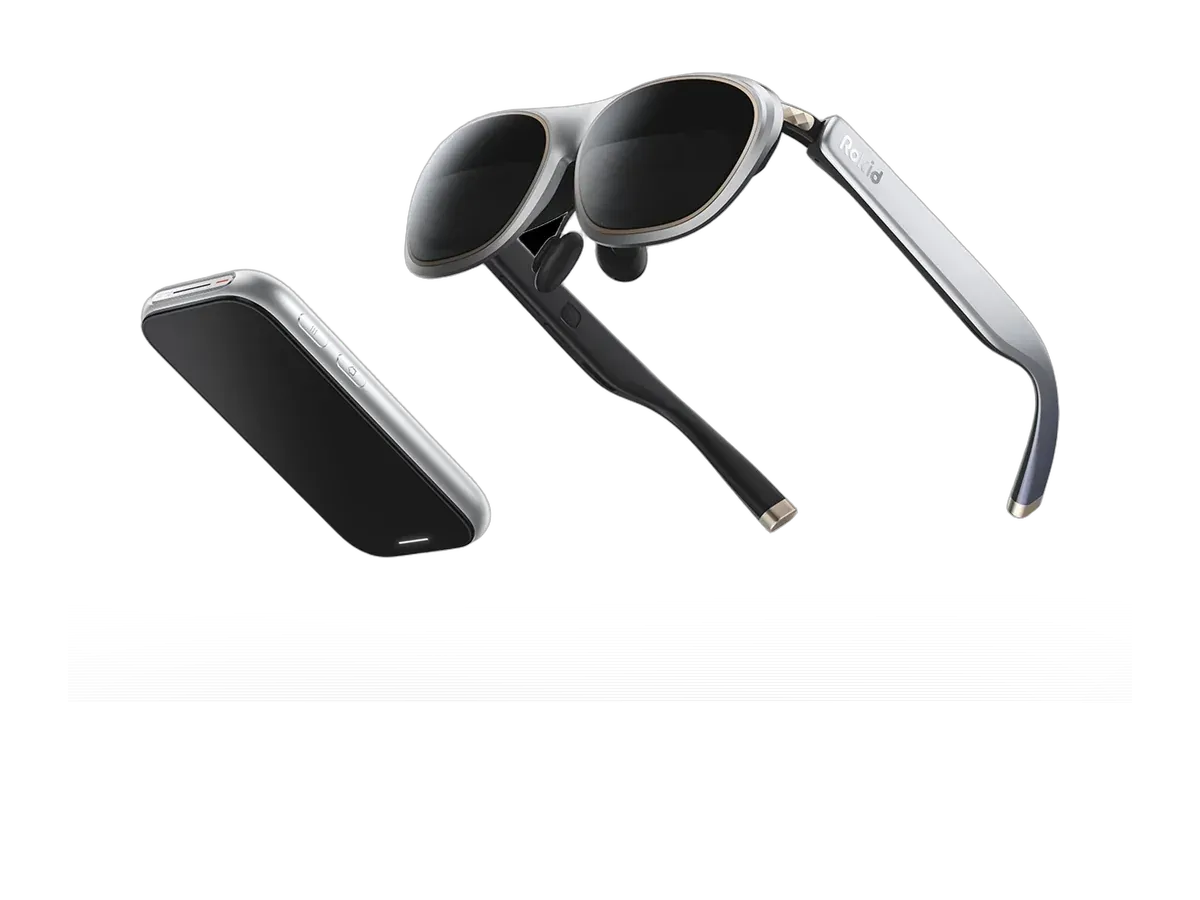
At a glance
- Display type
- Sony 0.68" Micro-OLED (Max 2 glasses)
- Resolution
- 1920x1080
- Field of view
- 50°
- Refresh rate
- 90 Hz
- Brightness
- 600 nits
- Weight
- 75 g
- Battery
- 5 hr
- Complete self-contained kit: glasses + Android-based spatial computer
- 3-window spatial multitasking with 3DoF head-anchored screens
- Runs Max 2 output at 90Hz (not the glasses' full 120Hz)
- Pricier than budget birdbath display glasses (~$558 street)
Rokid AR Spatial
Rokid
7.4/10 “The aggregated consensus frames the Rokid AR Spatial as the most complete self-contained pick in the wired-glasses field: the Max 2 glasses plus the Station 2 spatial computer deliver up to three head-anchored windows on a claimed 300-inch display with no phone or laptop required, and the 75-gram glasses with built-in 0 to -6.00D myopia dials draw the same comfort praise the Max 2 earns. How-To Geek's hands-on scored it 8/10 and called it genuinely plug-and-play. The recurring criticisms are equally consistent: the Station 2 gates IPD alignment and the best spatial modes behind the paid hub, three-screen multitasking is restricted to DLNA on Android, spatial output drops to 90Hz, the fan is audible under load, and the YodaOS software and companion app trail the hardware. Owners' advice is to buy it on discount as a portable multi-monitor and travel cinema for nearsighted eyes -- and to temper productivity expectations.” Read the full review$558
Check price at Amazon- Field of view
- 50°
- Weight
- 75 g
- Battery
- 5 hr
The Rokid AR Spatial are augmented-reality glasses from Rokid, released 2025-01. They feature a 1920x1080 per-eye Sony 0.68" Micro-OLED (Max 2 glasses), 50° field of view, 600 nits perceived brightness, 90Hz refresh rate. Weight is 75g. Best for: Mobile professionals who want a pocketable multi-window virtual monitor system without tethering to a laptop or phone.
Our review
By AR Compare Team ·
The aggregated consensus frames the Rokid AR Spatial as the most complete self-contained pick in the wired-glasses field: the Max 2 glasses plus the Station 2 spatial computer deliver up to three head-anchored windows on a claimed 300-inch display with no phone or laptop required, and the 75-gram glasses with built-in 0 to -6.00D myopia dials draw the same comfort praise the Max 2 earns. How-To Geek's hands-on scored it 8/10 and called it genuinely plug-and-play. The recurring criticisms are equally consistent: the Station 2 gates IPD alignment and the best spatial modes behind the paid hub, three-screen multitasking is restricted to DLNA on Android, spatial output drops to 90Hz, the fan is audible under load, and the YodaOS software and companion app trail the hardware. Owners' advice is to buy it on discount as a portable multi-monitor and travel cinema for nearsighted eyes -- and to temper productivity expectations.
- Display quality
- 8/10
- Comfort
- 8.5/10
- Battery life
- 5.5/10
- Value for money
- 7/10
- Build quality
- 7.5/10
- Software
- 6/10
The Rokid AR Spatial is not a single device but a bundle: the Rokid Max 2 birdbath display glasses paired with the Rokid Station 2, an Android-based spatial computer that turns the glasses from a passive external monitor into a self-contained three-window workspace. This review aggregates the crowdsourced record around that kit — How-To Geek’s dedicated hands-on, The Gadgeteer’s bundle review, Techlicious’s launch coverage, and, because the AR Spatial’s glasses are literally the Max 2, the professional and owner reviews of those glasses (AppleInsider, Serious Insights, AndroidGuys). AR Compare has not performed hands-on testing of this kit; all observations below are attributed to the cited sources, and the category scores are an editorial aggregate of cited reviewer and owner sentiment. Where a claim is specific to the standalone Max 2 glasses rather than the Station 2 experience, that is flagged.
How This Review Was Compiled
Sources include How-To Geek’s full hands-on review (scored 8/10), The Gadgeteer’s deal-and-workflow writeup, Techlicious’s launch report, AppleInsider’s Max 2 review (2.5/5, focused on the glasses-plus-Station combo), and long-form Max 2 coverage from Serious Insights and AndroidGuys. Product facts were cross-checked against AR Compare’s own spec record for the Rokid AR Spatial (Sony 0.68-inch Micro-OLED, 1920x1080 per eye, 50-degree FOV, 600 nits, 90Hz in spatial mode, 75 grams, 3DoF, Station 2 with 8GB RAM / 128GB storage / 5,000 mAh) and the $648 launch / roughly $700 street pricing in the database. The consensus and the complaints below recur across nearly all of the cited coverage.
The Station 2: The Reason This Is “Spatial” and Not Just a Monitor
What separates the AR Spatial bundle from buying Max 2 glasses alone is the Station 2, a pocketable Android box running YodaOS-Master, a deeply customized AOSP build. According to How-To Geek, it performs “like a mid-tier Android smartphone or tablet” with no lag, logs into the Google Play Store and Chrome plus Rokid’s own store, and pairs with Bluetooth keyboards, mice and gamepads. Its defining trick is spatial multitasking: YodaOS-Master stacks virtual windows around you — The Gadgeteer describes pinning “a browser to your left, a video in the center, and a productivity app to your right, each anchored to a spot in the room.” Reviewers consistently report that up to three app windows can float in space “without being laggy or confusing to control,” and that the multitasking “feels native.” The Station 2 also carries the 5,000 mAh battery that makes the whole rig untethered for roughly five hours, charging over either USB-C port while in use.
Display and Comfort
The glasses themselves are the Max 2: dual Sony 0.68-inch Micro-OLED panels at 1920x1080 per eye, a roughly 50-degree field of view, and a claimed 300-inch virtual screen viewed from about 20 feet. How-To Geek called clarity and color “excellent,” if with slight edge blur and no HDR vibrancy, and noted the perceived display seemed “at least slightly larger” than rival glasses. Sport Mode keeps the image locked while you move — shifting in a seat or walking through an airport terminal. One nuance the crowdsourced record is careful about: the panels can hit 120Hz, but in the Station 2 spatial mode the output runs at 90Hz, which matches AR Compare’s spec record.
Comfort is a consensus strength inherited straight from the Max 2. At 75 grams the glasses are lighter than the XREAL 1S (82g) and One Pro (88g) per The Gadgeteer, “light enough to forget,” and How-To Geek found them comfortable even after hours of wear. The built-in per-eye myopia dials (0 to -6.00D) draw the same praise here as on the standalone Max 2: nearsighted users up to -6D get sharp visuals with no prescription inserts, a feature Techlicious and Rokid bill as the “world’s first intelligent myopia and interpupillary adjustment system in an AR headset,” with software IPD spanning 53mm to 75mm.
Pain Points Owners and Reviewers Report
The Station 2 paywall on alignment and modes. As with the Max 2, software IPD adjustment lives only in the Station 2 — How-To Geek’s reviewer felt it “should have been a physical option like the diopter adjustments.” The higher-resolution 3DoF spatial experience likewise depends on the Station 2, and owner reports surfaced in Max 2 coverage note that without the hub you “can’t place menus or situate documents,” forcing repeated glasses repositioning.
Multitasking and streaming caveats. The three-window headline comes with fine print reviewers flag: three-screen mode “only works via DLNA on Android,” while Miracast and Chromecast fall back to a single screen, and Netflix and Apple TV are restricted to 0DoF mode with no spatial depth. So the full spatial multi-monitor promise is real but conditional on how you feed content in.
Fan, software polish and text entry. Multiple reviewers note the Station 2 fan becomes “audible after a few minutes of normal operation,” and AppleInsider found that downloading apps while juggling three menus made the fans “rev up considerably” — convincing that reviewer the kit is “more of a media device” than a productivity tool. How-To Geek called the separate companion Rokid app “quite buggy and difficult to use.” On-device text entry is slow without a Bluetooth keyboard, and the YodaOS app store remains limited versus mainstream platforms.
Connectivity gaps. There is no HDMI power passthrough, so consoles need a separately sourced powered HDMI-to-USB-C adapter with what How-To Geek called “spotty” compatibility. And like all display glasses, the eyewear has no battery of its own; it draws from the Station 2 or whatever host you plug into.
Value
At its $648 launch (street price has drifted to roughly $700, with periodic Prime Day discounts reported near $499-$578), the aggregate calculus is conditional but favorable for the right buyer. The Gadgeteer’s math is the clearest articulation: the Max 2 glasses alone run around $399-$449, so bundling the Station 2 at a discount “changes the math considerably,” and the combination of standalone compute, built-in display and vision correction is rare under $1,000. The counterweight is the software: AppleInsider scored the glasses-plus-Station combo just 2.5/5, citing limited ecosystem integration and a Station 2 “unfit for heavy work,” while How-To Geek’s 8/10 reflects how much the plug-and-play spatial experience impressed as a media-and-light-work rig. Scores here are aggregates of those cited reviews and owner reports, not AR Compare hands-on measurements.
Who Should Buy the Rokid AR Spatial
Per the aggregated consensus: mobile professionals and travelers who want a genuinely pocketable multi-window virtual monitor with no laptop or phone tether, nearsighted buyers (0 to -6D) who value the zero-insert diopter dials, and media-first users who want a private 300-inch cinema plus casual three-window multitasking. Who should skip: heavy-productivity users who need edge-to-edge text clarity and a mature app ecosystem, console-first gamers unwilling to source a finicky powered HDMI adapter, and anyone expecting silent, workday-length operation — the fan noise, 90Hz cap and roughly five-hour battery point to a companion device, not a desktop replacement. Buyers who only want video glasses, several reviewers note, can spend less by skipping the Station 2 entirely.
Scores are aggregates of the cited reviews and owner reports, not AR Compare hands-on results.
Sources
- How-To Geek — Rokid AR Spatial Review: A 300-inch Interactive Virtual Display Experience (Bill Loguidice, 8/10)
- The Gadgeteer — Rokid Just Made the Case for Ditching Your Second Monitor (Rei Padla)
- Techlicious — Rokid Launches AR Spatial Glasses with 300-Inch Virtual Display (Josh Kirschner)
- AppleInsider — Rokid Max 2 AR Glasses review: Hardware shines, software needs polish (Thomas Sibilly, 2.5/5)
- Serious Insights — Rokid Max 2 AR Glasses Review: Better as Media Consumption Companion Than a Work Display
- AndroidGuys — Rokid Max 2 AR Glasses Review: A Stunning Visual Experience
- Rokid — Rokid AR Spatial official product page (specifications)
Pros & cons
Pros
- Complete self-contained kit: glasses + Android-based spatial computer
- 3-window spatial multitasking with 3DoF head-anchored screens
- About 5 hours of untethered use from Station 2 battery
- Cheaper than buying into standalone headsets for a portable multi-monitor setup
- Up to three spatial windows on a claimed 300-inch virtual display; reviewers call the multitasking near-native and lag-free
- Built-in per-eye myopia adjustment from 0 to -6.00D on 75-gram, Sony Micro-OLED glasses that testers repeatedly call comfortable for hours
Cons
- Runs Max 2 output at 90Hz (not the glasses' full 120Hz)
- Pricier than budget birdbath display glasses (~$558 street)
- YodaOS app ecosystem is limited vs. mainstream platforms
- 3DoF only — no positional (6DoF) tracking
- Software IPD alignment and the higher-resolution 3DoF spatial modes are locked to the paid Station 2, and the companion Rokid app is described as buggy
- Three-screen mode only works via DLNA on Android; Miracast, Chromecast, Netflix and Apple TV drop to a single 0DoF screen
- No HDMI power passthrough, so consoles need a separately sourced powered adapter with spotty compatibility
Full specifications
| Display | |
|---|---|
| Display type | Sony 0.68" Micro-OLED (Max 2 glasses) |
| Resolution | 1920x1080 |
| Pixels per degree | 38 |
| Field of view (°) | 50 |
| Refresh rate (Hz) | 90 |
| Brightness (nits) | 600 |
| Virtual screen size (in) | 300 |
| HDR support | ✕ No |
| Color support | Full color |
| Optics | |
| Optics type | birdbath |
| Dimming control | ✕ No |
| Prescription support | ✓ Yes |
| Prescription options | Built-in dials, -6.00 to 0.00 |
| Not published: Transparency level | |
| Physical | |
| Weight (g) | 75 |
| Frame style | glasses |
| Foldable | ✕ No |
| Not published: Color options, IP rating | |
| Battery & power | |
| Battery life (hours) | 5 |
| Not published: Charging method, Charging time | |
| Connectivity | |
| Connectivity | USB-C |
| Tethered | ✕ No |
| Compatible devices | Rokid Station 2 |
| Computing | |
| Operating system | YodaOS-Master (Android-app compatible) |
| Chipset | Rokid Station 2: 8GB RAM / 128GB storage, 5000 mAh |
| Not published: Processing type | |
| Sensors & input | |
| Camera | ✕ No |
| Speakers | open-ear |
| Tracking | 3DoF |
| Gesture control | ✕ No |
| Voice control | ✕ No |
| Not published: Microphones, AI assistant | |
Prescription options
The documented prescription routes for the Rokid AR Spatial, from the maker and named-partner documentation recorded in our database.
- Built-in dials, -6.00 to 0.00 Source: global.rokid.com documentation
Maker documentation as recorded 2026-09-17. Ranges are the maker's published limits, not medical advice — confirm your exact prescription with your optician before ordering.
Where to buy
Price verified
Rokid AR Spatial specs: quick answers
- What is the Rokid AR Spatial's field of view?
- The Rokid AR Spatial has a 50-degree field of view.
- What is the Rokid AR Spatial's display resolution?
- The Rokid AR Spatial's recorded per-eye display resolution is 1920x1080.
- How bright is the Rokid AR Spatial's display?
- The Rokid AR Spatial has a rated peak brightness of 600 nits.
- How much does the Rokid AR Spatial weigh?
- The Rokid AR Spatial's glasses weigh 75g according to the manufacturer specification.
- How long does the Rokid AR Spatial's battery last?
- The Rokid AR Spatial is rated for about 5 hours of battery life.
- How much does the Rokid AR Spatial cost?
- The Rokid AR Spatial costs $558.
Rokid AR Spatial: FAQs
How much does the Rokid AR Spatial cost?
The Rokid AR Spatial costs $558 (USD). It is available from 2 retailers listed on this page.
What field of view does the Rokid AR Spatial have?
The Rokid AR Spatial has a recorded field of view of 50 degrees.
How much does the Rokid AR Spatial weigh?
The Rokid AR Spatial weighs 75g according to the manufacturer specification.
How long does the battery last on the Rokid AR Spatial?
The Rokid AR Spatial has a rated battery life of 5 hours.
Can I use the Rokid AR Spatial with prescription lenses?
Yes, the Rokid AR Spatial supports prescription lenses. The recorded diopter range is Built-in myopia adjustment 0 to -6.00D.
What devices work with the Rokid AR Spatial?
The Rokid AR Spatial lists compatibility with: Rokid Station 2.
What resolution does the Rokid AR Spatial have?
The Rokid AR Spatial has a recorded per-eye resolution of 1920x1080. It refreshes at 90Hz.
Is the Rokid AR Spatial worth it?
The Rokid AR Spatial is priced at $558 (USD). For that you get a 50-degree field of view, 600 nits of brightness, a 1920x1080 per-eye resolution, and 5 hours of rated battery life. It weighs 75g. The full spec breakdown on this page shows what the price includes.
Ranked in these buying guides
Where the Rokid AR Spatial lands in our recorded-spec rankings.
Related Comparisons
Rokid AR Spatial vs Inmo Air2
Inmo
Rokid AR Spatial vs TCL RayNeo X2
RayNeo
Rokid AR Spatial vs Mad Gaze Glow Plus
Mad Gaze
Rokid AR Spatial vs Vuzix Blade 2
Vuzix
Rokid AR Spatial vs INMO Air3 All-in-One Full-Color Waveguide AR Glasses
Inmo
Rokid AR Spatial vs Dream Glass Lead Pro
Dreamworld
Rokid AR Spatial vs Epson Moverio BT-45C
Epson
Rokid AR Spatial vs Lenovo ThinkReality A3
Lenovo