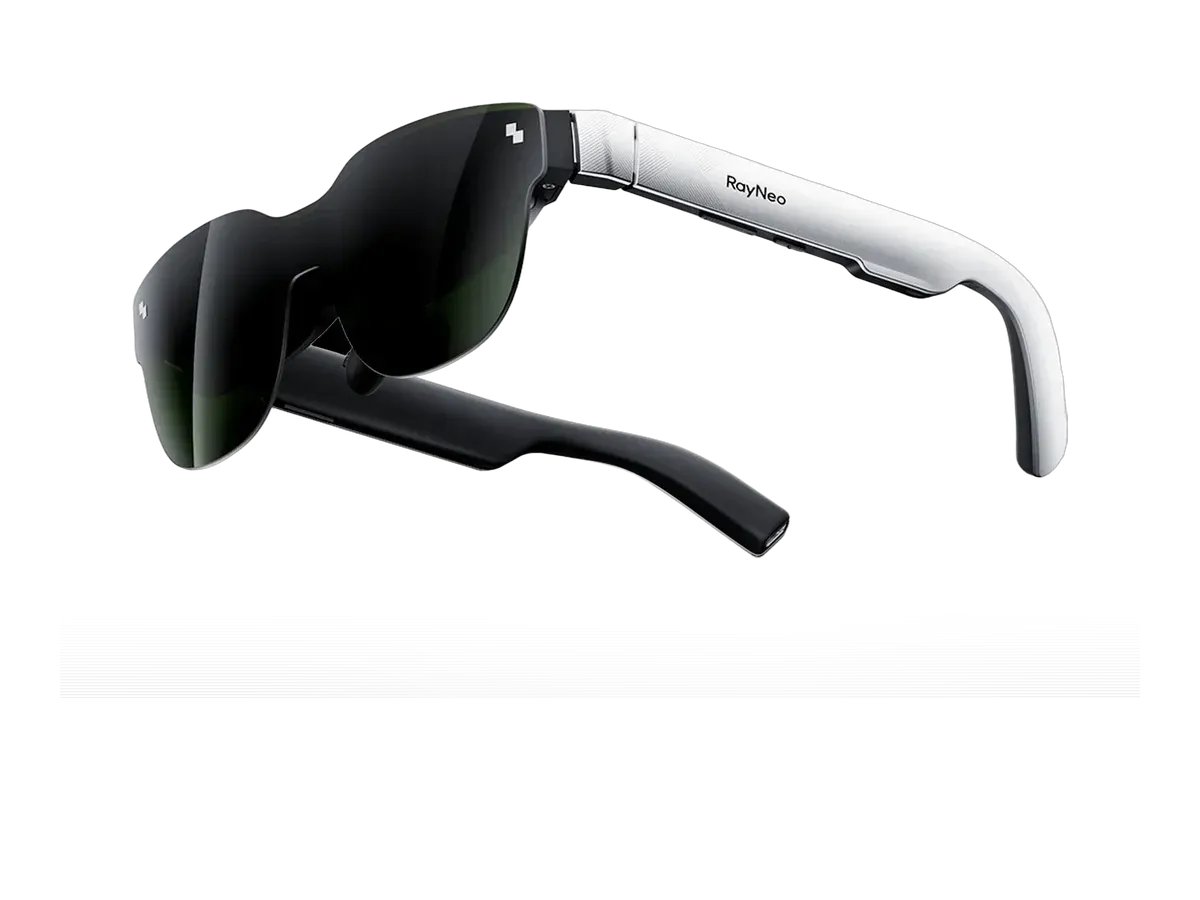
At a glance
- Display type
- Micro-OLED (HueView optical engine), IMAX Enhanced certified
- Resolution
- 1920x1080
- Field of view
- 46°
- Refresh rate
- 120 Hz
- Brightness
- 650 nits
- Weight
- 76 g
- IMAX Enhanced certified for cinema-quality viewing experience
- Affordable at $199 -- excellent entry point for display glasses
- 650 nits brightness significantly lower than Air 4 Pro (1200 nits)
- No HDR10 support -- standard dynamic range only
RayNeo Air 3s
RayNeo
8.2/10 “The aggregated verdict on the RayNeo Air 3s is the most lopsided in the budget tier: TechRadar called them the best budget smart glasses it has tested and the pair its reviewer would buy with their own money, Android Central judged them possibly the best budget XR glasses ever made, and Tom's Guide said they blew reviewers away at $269. The compromises owners flag are real -- no electrochromic dimming, noticeable light leak in bright spaces, a fixed IPD window, and no spatial features -- but at a price roughly half an XREAL One, the consensus is that nothing else comes close for private movie nights and travel. This is the crowd's default answer to the question of the cheapest display glasses worth buying.” Read the full review$269 typical · $199 at RayNeo Store
Check price at Amazon- Field of view
- 46°
- Weight
- 76 g
- Brightness
- 650 nits
The RayNeo Air 3s is an IMAX Enhanced-certified display glasses offering a 201-inch virtual screen with dual 1080p Micro-OLED displays at 120Hz. It delivers 650 nits brightness with a 200,000:1 contrast ratio, 145% sRGB, and 98% DCI-P3 color gamut coverage. The balanced 46.7%:53.3% weight distribution and 9-level adjustable temples ensure comfortable extended wear at just 76g.
Our review
By AR Compare Team ·
The aggregated verdict on the RayNeo Air 3s is the most lopsided in the budget tier: TechRadar called them the best budget smart glasses it has tested and the pair its reviewer would buy with their own money, Android Central judged them possibly the best budget XR glasses ever made, and Tom's Guide said they blew reviewers away at $269. The compromises owners flag are real -- no electrochromic dimming, noticeable light leak in bright spaces, a fixed IPD window, and no spatial features -- but at a price roughly half an XREAL One, the consensus is that nothing else comes close for private movie nights and travel. This is the crowd's default answer to the question of the cheapest display glasses worth buying.
- Display quality
- 8.5/10
- Comfort
- 8/10
- Battery life
- 5.5/10
- Value for money
- 9.5/10
- Build quality
- 7/10
- Software
- 6.5/10
The RayNeo Air 3s is the product that made the sub-$300 display glasses tier respectable, according to the aggregated consensus of reviewers at TechRadar, Android Central, Tom’s Guide, and Cybernews, plus owner feedback across retail listings and enthusiast communities. This review compiles that record. AR Compare has not performed hands-on testing of this unit; every observation is attributed to the cited sources, and the category scores are an editorial aggregate of cited reviewer and owner sentiment.
How This Review Was Compiled
Sources include scored professional reviews, a ReviewsTown movie-focused evaluation, coverage of the closely related Air 3s Pro (Tom’s Guide, Tom’s Hardware, How-To Geek) where it illuminates the base model, and recurring owner themes from retailer reviews. Where the Pro differs, that is flagged.
The Value Story
Start with the verdicts, because they are unusually uniform. TechRadar: the best budget smart glasses tested, beating several pricier pairs, with sound and image quality at $269 that “has to be experienced to be believed.” Android Central: RayNeo “may have crafted the best budget XR glasses.” Tom’s Guide: the best pair of AR glasses “without breaking the bank.” Street pricing strengthens the case — the Air 3s has been spotted at $239 with coupon codes, and bundles with RayNeo’s Pocket TV Google TV dongle run around $322.
Display and Comfort
The dual 1080p Micro-OLED panels at up to 120Hz project a claimed 201-inch virtual screen — a figure that, as reviewers responsibly note, is a virtual equivalent at a fixed reference distance; the actual roughly 46-47 degree field of view feels like sitting in the middle rows of a home theater. Within that frame, color and contrast draw consistent praise, and reviewers specifically note that color fringing is considerably reduced versus past RayNeo models thanks to a new image engine, with 3840Hz DC dimming easing flicker concerns.
Comfort reports are positive for the class: multiple users describe wearing the 76-gram glasses for hours without strain. The realistic ceiling owners describe is two-hour sessions comfortably, with roughly three hours as the upper limit before eye fatigue — and a short adaptation period of a few days for new users.
Pain Points Owners Report
Ambient light is the big one. There is no electrochromic dimming at this price, and the darkened front shade does not block out the world. Owners report noticeable light leakage outdoors and in bright rooms, and one review notes that in a daytime window seat on a plane, the display is nearly unwatchable without the physical shade pulled down. Buyers who need bright-environment performance are pointed to the Air 3s Pro, which doubles brightness to 1,200 nits for about $100 more — How-To Geek argued the Pro is the clear choice for that reason, while Tom’s Guide was more skeptical of the Pro’s trade-offs.
Fit window. The IPD range is 56-70mm with no adjustment path; users outside it cannot achieve proper alignment. Prescription inserts are available covering 0 to -10.00D myopia and up to -2.00D astigmatism — an unusually wide insert range, though inserts cost extra.
No spatial features. There is no 3DoF anchoring, no ultrawide modes, no onboard compute. The screen is head-locked, full stop. Reviewers frame this as the honest cost of the price point rather than a flaw, but owners upgrading from XREAL One-class hardware notice it immediately.
Value Against the Field
The aggregate positioning: the Air 3s owns the sub-$300 tier. Above it, the RayNeo Air 4 Pro at $299 adds HDR10 and better audio; the XREAL 1S at $449 adds on-device 3DoF and electrochromic dimming. Below it, nothing credible exists. For a first pair of display glasses bought on price, the consensus recommendation is this one. To see the whole value field sorted from recorded prices, start with the best budget AR glasses ranking.
Who Should Buy the RayNeo Air 3s
Per the aggregated consensus: budget-conscious buyers wanting a private cinema for travel, dorms, and shared living rooms; handheld gamers adding a big screen to a Steam Deck or phone; and first-timers testing whether display glasses fit their life without a $500 commitment. Who should skip: anyone who works in bright rooms or outdoors, users outside the 56-70mm IPD window, and buyers who want anchoring, productivity multi-screen, or any true AR functionality.
Scores are aggregates of the cited reviews and owner feedback, not AR Compare hands-on measurements.
Sources
- TechRadar — RayNeo Air 3s: unbeatable value from these budget AR smart glasses
- Android Central — RayNeo Air 3S review: These XR glasses are an unbeatable value
- Cybernews — RayNeo Air 3s Review: Are These AR Smart Glasses Worth It?
- ReviewsTown — RayNeo Air 3s Review: Best AR Glasses for Watching Movies
- Tom’s Guide — RayNeo Air 3s Pro AR Glasses Review: Brighter But at What Cost?
- Tom’s Hardware — RayNeo Air 3s Pro review: A meaningful usability upgrade for already stellar glasses
- How-To Geek — RayNeo Air 3s Pro Review: Budget-Friendly AR/XR Video Glasses
Pros & cons
Pros
- IMAX Enhanced certified for cinema-quality viewing experience
- Affordable at $199 -- excellent entry point for display glasses
- 200,000:1 contrast ratio with 98% DCI-P3 color gamut
- 9-level adjustable temples and 3-level nose pads for universal fit
- 120Hz refresh rate for smooth gaming and video
- Repeatedly named the best-value display glasses on the market at $269, often discounted to around $239
- 201-inch virtual Micro-OLED screen at 120Hz with vibrant color and reduced fringing versus earlier RayNeos
- 3840Hz DC dimming and a new image engine, unusual refinements at this price
- Owners report multi-hour comfort and painless plug-and-play across phones, PCs, and handhelds
- Prescription insert support covers 0 to -10.00D myopia and up to -2.00D astigmatism
Cons
- 650 nits brightness significantly lower than Air 4 Pro (1200 nits)
- No HDR10 support -- standard dynamic range only
- No electrochromic dimming control
- Basic stereo speakers without B&O tuning
- No built-in myopia adjustment -- requires prescription inserts
- 56-70mm IPD range excludes users outside it, with no adjustment path
- No spatial or anchoring features; this is a fixed head-locked screen
- Eye fatigue commonly caps sessions around two to three hours
Full specifications
| Display | |
|---|---|
| Display type | Micro-OLED (HueView optical engine), IMAX Enhanced certified |
| Resolution | 1920x1080 |
| Pixels per degree | 42 |
| Field of view (°) | 46 |
| Refresh rate (Hz) | 120 |
| Brightness (nits) | 650 |
| Virtual screen size (in) | 201 |
| HDR support | ✕ No |
| Color support | Full color |
| Optics | |
| Optics type | birdbath |
| Dimming control | ✓ Yes |
| Prescription support | ✓ Yes |
| Prescription options | Inserts / lens frame via Lensology, -10.00 to 0.00, cyl up to 2.00, £95 GBP flat at partner (partner-sourced) |
| Not published: Transparency level | |
| Physical | |
| Weight (g) | 76 |
| Frame style | wraparound |
| Color options | Dark Gray |
| Foldable | ✓ Yes |
| Not published: IP rating | |
| Battery & power | |
| Charging method | USB-C (powered by connected device) |
| Not published: Battery life, Charging time | |
| Connectivity | |
| Connectivity | USB-C |
| Tethered | ✓ Yes |
| Compatible devices | Android, iOS, PC, Mac, Steam Deck, Nintendo Switch, PlayStation 5, ROG Ally |
| Computing | |
| Processing type | tethered |
| Operating system | None (plug-and-play external display) |
| Chipset | None (tethered display glasses) |
| Sensors & input | |
| Camera | ✕ No |
| Microphones | 2 |
| Speakers | directional |
| Gesture control | ✕ No |
| Voice control | ✕ No |
| Not published: Tracking, AI assistant | |
Prescription options
The documented prescription routes for the RayNeo Air 3s, from the maker and named-partner documentation recorded in our database.
- Inserts / lens frame via Lensology, -10.00 to 0.00, cyl up to 2.00, £95 GBP flat at partner (partner-sourced) Source: rayneo.com documentation
Maker documentation as recorded 2026-09-17. Ranges are the maker's published limits, not medical advice — confirm your exact prescription with your optician before ordering.
Where to buy
Price verified
RayNeo Air 3s specs: quick answers
- What is the RayNeo Air 3s's field of view?
- The RayNeo Air 3s has a 46-degree field of view.
- What is the RayNeo Air 3s's display resolution?
- The RayNeo Air 3s's recorded per-eye display resolution is 1920x1080.
- How bright is the RayNeo Air 3s's display?
- The RayNeo Air 3s has a rated peak brightness of 650 nits.
- How much does the RayNeo Air 3s weigh?
- The RayNeo Air 3s's glasses weigh 76g according to the manufacturer specification.
- How much does the RayNeo Air 3s cost?
- The RayNeo Air 3s costs $269.
RayNeo Air 3s: FAQs
How much does the RayNeo Air 3s cost?
The RayNeo Air 3s costs $269 (USD). It is available from 2 retailers listed on this page.
What field of view does the RayNeo Air 3s have?
The RayNeo Air 3s has a recorded field of view of 46 degrees.
How much does the RayNeo Air 3s weigh?
The RayNeo Air 3s weighs 76g according to the manufacturer specification.
Can I use the RayNeo Air 3s with prescription lenses?
Yes, the RayNeo Air 3s supports prescription lenses. The recorded diopter range is Clip-in Rx insert frame in box (lenses separate via Lensology); myopia to -10.00D, astigmatism to -2.00D.
What devices work with the RayNeo Air 3s?
The RayNeo Air 3s lists compatibility with: Android, iOS, PC, Mac, Steam Deck, Nintendo Switch, PlayStation 5, ROG Ally.
What resolution does the RayNeo Air 3s have?
The RayNeo Air 3s has a recorded per-eye resolution of 1920x1080. It refreshes at 120Hz.
Are the RayNeo Air 3s good for gaming?
The RayNeo Air 3s runs at a recorded 120Hz refresh rate with a 46-degree field of view -- the display specs that matter most for gaming. It is tethered, drawing video from a connected phone, PC, or console rather than running games on its own.
Is the RayNeo Air 3s worth it?
The RayNeo Air 3s is priced at $269 (USD). For that you get a 46-degree field of view, 650 nits of brightness, and a 1920x1080 per-eye resolution. It weighs 76g. It is tethered, so it needs a connected phone, PC, or console to run rather than working on its own. The full spec breakdown on this page shows what the price includes.
Ranked in these buying guides
Where the RayNeo Air 3s lands in our recorded-spec rankings.
- Best AR Glasses for Gaming
- Best AR Glasses for Steam Deck
- Best AR Glasses for Movies & Travel
- Best AR Glasses for Productivity & Multi-Monitor Work
- Best AR Glasses for iPhone Users
- Best Budget AR Glasses & Smart Glasses
- Prescription Smart Glasses
- The Best Smart Glasses of 2026
- AR Glasses Under $300
- Smart Glasses With a Display
- Lightest Smart Glasses
Related Comparisons
RayNeo Air 3s vs RayNeo Air 4 Pro
RayNeo
RayNeo Air 3s vs XREAL 1S
RayNeo vs XREAL
RayNeo Air 3s vs Rokid Max
RayNeo vs Rokid
RayNeo Air 3s vs VITURE One Lite
RayNeo vs VITURE
RayNeo Air 3s vs Rokid Max 2
RayNeo vs Rokid
RayNeo Air 3s vs RayNeo Air 2
RayNeo
RayNeo Air 3s vs XREAL Air 2 Pro
RayNeo vs XREAL
RayNeo Air 3s vs VITURE Luma XR
RayNeo vs VITURE
RayNeo Air 3s vs RayNeo Air 3s Pro AR/XR Glasses
RayNeo
RayNeo Air 3s vs XREAL Air 2
RayNeo vs XREAL
RayNeo Air 3s vs VITURE Pro XR
RayNeo vs VITURE