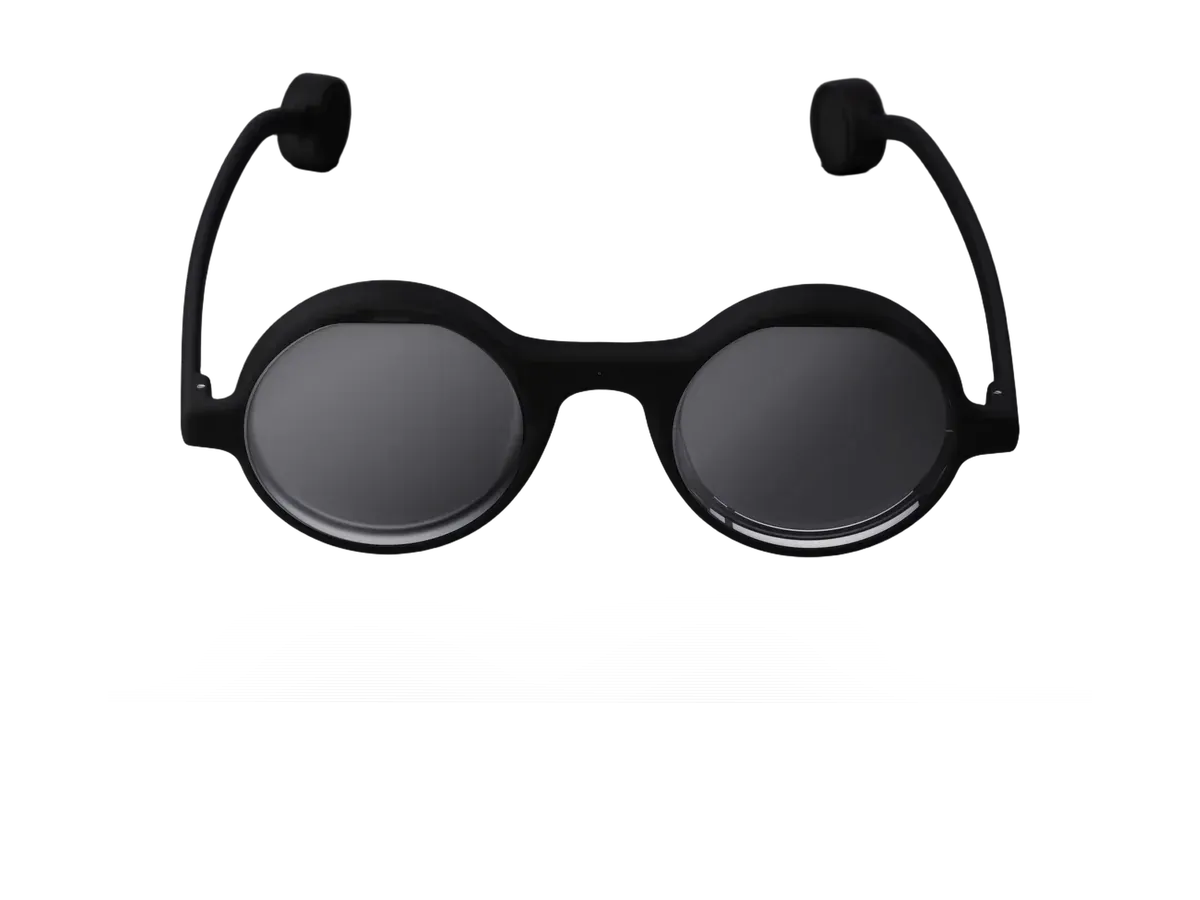
At a glance
- Display type
- Micro-OLED prism
- Resolution
- 640x400
- Field of view
- 20°
- Weight
- 40 g
- Battery
- 4 hr
- Fully open-source hardware and software -- highly customizable
- Color micro-OLED display in a 40g lightweight frame
- 20-degree FOV is very narrow for the display
- Single microphone limits voice recognition quality
Brilliant Labs Frame
Brilliant Labs
5.5/10 “According to the aggregated consensus of reviewers, the Brilliant Labs Frame is an admirable open-source experiment that shipped before it was ready. Pocket-lint's 3/5 review calls it better as a proof of concept than anything else, and the record hardens with usage depth: 9to5Google's retail unit fought a broken companion app and a headache-inducing prism, while Sypnotix's two months of daily wear ended in unreliable answers, constant disconnects, and a reviewer who mostly wanted to take the glasses off. The open platform -- complete firmware source, published schematics, Python tooling -- is the consensus bright spot, and at $349 every reviewer points developers, not general consumers, at it. Scores below are an editorial aggregate of that cited coverage, not AR Compare hands-on measurements.” Read the full review$349
See current alternatives- Field of view
- 20°
- Weight
- 40 g
- Battery
- 4 hr
The Brilliant Labs Frame is an open-source smart glasses platform with a color micro-OLED display, 720p camera, and AI assistant -- all in lightweight frames designed for developers and tinkerers. Built on open hardware and software, the Frame runs the Noa AI assistant and supports custom applications through its developer-friendly ecosystem.
Our review
By AR Compare Team ·
According to the aggregated consensus of reviewers, the Brilliant Labs Frame is an admirable open-source experiment that shipped before it was ready. Pocket-lint's 3/5 review calls it better as a proof of concept than anything else, and the record hardens with usage depth: 9to5Google's retail unit fought a broken companion app and a headache-inducing prism, while Sypnotix's two months of daily wear ended in unreliable answers, constant disconnects, and a reviewer who mostly wanted to take the glasses off. The open platform -- complete firmware source, published schematics, Python tooling -- is the consensus bright spot, and at $349 every reviewer points developers, not general consumers, at it. Scores below are an editorial aggregate of that cited coverage, not AR Compare hands-on measurements.
- Display quality
- 4/10
- Comfort
- 6.5/10
- Battery life
- 5/10
- Value for money
- 4.5/10
- Build quality
- 4.5/10
- Software
- 4/10
The Brilliant Labs Frame is an open-source pair of AI smart glasses: round frames holding a single-eye prism display, a nose-bridge camera, and a cloud assistant called Noa, shipped to preorder buyers from spring 2024 at $349. It is not immersive AR and it is not standalone — the display shows short text and simple graphics to the right eye, and everything routes through a connected smartphone over Bluetooth. This review aggregates the hands-on record — Pocket-lint’s scored review, 9to5Google’s retail-unit hands-on, and Sypnotix’s long-term owner review — alongside Reviews.org’s launch coverage and Brilliant Labs’ published hardware documentation. AR Compare has not performed hands-on testing of this device; every observation below is attributed to the cited sources, and the category scores are an editorial aggregate of cited reviewer sentiment. Product facts were cross-checked against AR Compare’s spec record for the Frame (a recorded 640x400 Micro-OLED behind a prism optic, a recorded 20-degree field of view, a 720p camera, a single microphone, roughly 40 grams, Bluetooth 5.3, a recorded 4-hour battery rating, $349).
How This Review Was Compiled
The three hands-on sources scale in depth and descend in verdict. Pocket-lint’s Ian Carlos Campbell published the only scored review, a 3/5 after a week-plus of wear and the mildest reading in the record. 9to5Google’s Ben Schoon reviewed a retail delivery unit and is blunt about hardware and setup, while Sypnotix’s reviewer — a self-purchasing owner and former North Focals wearer — logged roughly two months of attempted daily use, the deepest usage period anywhere in the record, and came out most negative. Reviews.org’s preorder coverage supplies launch facts only, and Brilliant Labs’ own hardware documentation anchors the spec record. Where the sources disagree — battery, comfort, and how usable Noa is — both readings are reported below rather than smoothed over.
The Prism: What the Frame Actually Shows
The display is the most misunderstood part of the product, and the reviewers spend much of their word count resetting expectations. A tiny Micro-OLED at a recorded 640x400 is bounced through a geometric prism bonded into the right lens, filling a recorded 20-degree field of view with monochrome-leaning text and simple graphics — an interface of words and emoticons, not floating apps. Within that envelope the reviews are kind: Pocket-lint calls the visuals clear despite slight ghosting that shifts with nose position, and 9to5Google rates the text sharper and more legible than Google Glass managed a decade earlier.
The problem is everything around the image. 9to5Google calls the company’s invisible-display marketing frankly misleading, because the prism is plainly visible in the middle of the right lens, catches overhead light, and sat in the reviewer’s line of sight persistently enough to cause a headache within minutes. Sypnotix reports the same two ways: onlookers see a distorted right eye through the lens, and the wearer stares at a prism block in the center of vision even when the display is idle — the reason that review concludes the Frame fails even as plain eyewear. Imagery also floats at a fixed distance with no depth placement, per Pocket-lint.
Noa, Credits, and the Cloud AI
Noa, the companion assistant, does its thinking in the cloud: the phone app routes queries to hosted models — ChatGPT and Perplexity, per Pocket-lint, with the company citing multiple LLMs per 9to5Google — and returns text to the prism about three seconds later, holding context across follow-up questions. The record’s favorite touch is personality: owners can rename the assistant and retune its tone and writing style, which Sypnotix singles out as a genuine edge over Siri, Alexa, and Google Assistant. Translation is the standout use in practice, with 9to5Google’s unit correctly translating a French webpage and Sypnotix initially impressed by manga panels rendered readable through the camera.
Accuracy is where the deeper usage turns the record negative. Sypnotix documents the camera-versus-eye misalignment misidentifying objects repeatedly — a Bulbasaur plush called a Pikachu, an apple described first as a burger and later as a banana — and judges answers to repeated questions unreliable. The usage economy grates too: the free Welcome tier grants 2,000 credits a month, each tap costs roughly 3 to 15 of them per Sypnotix, and 9to5Google burned 178 in a couple of hours while noting the company never clearly defined what a credit buys. Paid tiers were not yet purchasable at review time, per Sypnotix, and the display cannot be manually switched off, spitting out idle facts that burn credits on their own, per 9to5Google.
Reliability: Where the Record Turns Harsh
Every reviewer hit connection trouble, and the two deepest reviews treat it as disqualifying. Pocket-lint’s biggest gripe was Bluetooth repeatedly disconnecting from Noa, forcing an app reopen and a tap-the-glasses ritual each time. Sypnotix describes frequent disconnections leaving a stylish brick, pairing that requires holding a SIM tool in a pinhole for the whole process, no power button anywhere on the hardware, and no battery percentage shown in the app or the phone’s Bluetooth menu. 9to5Google could not get past sign-in at all on a Pixel 8 Pro because the Android app was broken at retail launch, with a fix arriving only later. Nothing in the box documents setup; the reset procedure lives only on the company’s site.
Battery, Comfort, and Mister Power
Battery is a genuine disagreement, bracketed rather than resolved. AR Compare’s record carries a recorded 4-hour rating, while Pocket-lint reports roughly 6 hours of regular use — less under camera-heavy questioning — and close to 30 hours of standby from the 210mAh cell, a capacity the manufacturer’s hardware documentation confirms. Charging runs through Mister Power, a 140mAh nose-shaped accessory that clips onto the bridge and adds USB-C — the one hardware element 9to5Google praises, though Pocket-lint worried about losing the removable bridge piece and Sypnotix found it fights the magnetic nose pads.
Comfort splits by face. At roughly 40 grams with the weight balanced between bridge and temple tips, Pocket-lint found them easy to forget while wearing, and Sypnotix — otherwise the harshest source — calls them light, thin, and comfortable. The dissent is fit and fashion: 9to5Google reports the frames run small, flex excessively, and simply did not fit, comparing the thick, reflective round lenses to Benjamin Franklin spectacles. Prescription support is real, with a recorded -6 to +2 diopter range in AR Compare’s record. The remaining rough edges are mechanical: loose hinges and an oversensitive tap sensor that triggers the microphone during adjustments, per Pocket-lint.
Open Source: The Consensus Bright Spot
The one thing all sources respect is the openness. The complete firmware and FPGA source sit in a public repository under a permissive ISC licence, with schematics and printable 3D models published alongside Python and Flutter SDKs and a Lua API — everything needed, as Pocket-lint puts it, to build apps or even build a Frame of your own, a stance that review calls really commendable. The company’s stated reason is app-store independence, and Reviews.org’s launch framing agrees the product was aimed at hackers wiring the hardware to services of their choosing. This is why the harshest reviews still end warm toward the mission: 9to5Google groups the Frame with the era’s disappointing AI hardware yet treats it as a foundation for better glasses to come.
Value at $349
At $349, the aggregate advice splits cleanly by buyer. For general consumers, no source recommends it: Pocket-lint says wait and see, Sypnotix cannot see a world where it suits normal buyers, and 9to5Google advises against purchase unless you develop software. For tinkerers the calculus is different — a fully documented, permissively licensed wearable platform with a display, camera, and microphone at this price has no direct rival in the record. The purchase-path caveat is current: the maker’s own store page for the Frame no longer resolves even though the hardware documentation remains live, and Brilliant Labs’ newer Halo AI glasses now sit beside it in AR Compare’s catalog. Where the Frame ranks among assistant-first eyewear is on the best smart glasses for AI assistants hub.
Who Should Buy the Brilliant Labs Frame
Per the aggregated consensus: developers and hardware tinkerers who want the most open smart-glasses platform on record — full source, schematics, and SDKs — and who will treat flaky connectivity as a bug list rather than a dealbreaker. Who should skip: anyone wanting a daily-driver assistant, given the disconnects and misidentification the two longest tests document; buyers sensitive to a visible prism sitting in one eye’s view; anyone expecting all-day battery or even a battery gauge; and shoppers who need a guaranteed retail path today.
Scores are aggregates of the cited reviews and hands-on reports, not AR Compare hands-on results.
Sources
- Pocket-lint — Brilliant Labs Frame review: Smart glasses are going to be popular, just not yet
- 9to5Google — Hands-on: Frame by Brilliant Labs is a disappointing stepping stone to something better
- Sypnotix — Brilliant Labs Frame Review
- Reviews.org — These hacker-friendly AI smartglasses sure look goofy
- Brilliant Labs — Frame hardware documentation (specifications)
- Brilliant Labs — frame-codebase: the complete Frame firmware and FPGA source (ISC licence)
What other reviewers say
Scores from other outlets, as published — not our rating.
| Source | Score |
|---|---|
| Pocket-lint | 3/5 |
Pros & cons
Pros
- Fully open-source hardware and software -- highly customizable
- Color micro-OLED display in a 40g lightweight frame
- Built-in 720p camera enables visual AI features
- Active developer community and growing app ecosystem
- Prescription lens support with adjustable optics
- Complete firmware and FPGA source published under a permissive licence, with schematics and printable models reviewers call genuinely commendable
- Light and balanced enough that reviewers report forgetting the glasses were on, with the cells split between bridge and temples
- An assistant persona owners can rename and retune, singled out in the record as a real edge over phone assistants
- Live translation wins in the record, from a French webpage to manga panels read through the camera
Cons
- 20-degree FOV is very narrow for the display
- Single microphone limits voice recognition quality
- No built-in speakers -- requires separate earbuds for audio
- 4-hour battery life is short for all-day wear
- Developer-focused -- requires technical comfort for best experience
- Bluetooth connections reviewers describe dropping constantly, leaving the glasses what one owner called a stylish brick
- A visible prism that sits in the wearer's line of sight, blamed in one hands-on for a headache within minutes
- No power button and no battery readout anywhere, with pairing that requires holding a SIM tool in a pinhole
- An opaque credit system that burned through hundreds of monthly credits in hours of ordinary question-asking
- Object recognition reviewers found unreliable, mislabeling toys and food across consecutive attempts
Full specifications
| Optics | |
|---|---|
| Optics type | prism |
| Dimming control | ✕ No |
| Prescription support | ✓ Yes |
| Prescription options | -6 to +2 |
| Not published: Transparency level | |
| Physical | |
| Weight (g) | 40 |
| Frame style | round classic |
| Color options | Clear, Grey |
| Foldable | ✓ Yes |
| Not published: IP rating | |
| Battery & power | |
| Battery life (hours) | 4 |
| Charging method | USB-C via Mister Power charging dock |
| Charging time (min) | 1 |
| Connectivity | |
| Connectivity | Bluetooth 5.3 |
| Tethered | ✕ No |
| Compatible devices | iOS, Android |
| Computing | |
| Processing type | phone |
| Operating system | open-source (Noa firmware) |
| Chipset | Nordic nRF52840 + Lattice FPGA |
| Sensors & input | |
| Camera | 720p |
| Microphones | 1 |
| Speakers | ✕ No |
| Gesture control | ✕ No |
| Voice control | ✓ Yes |
| AI assistant | Noa AI (open-source) |
| Not published: Tracking | |
Where to buy
Brilliant Labs Frame specs: quick answers
- What is the Brilliant Labs Frame's field of view?
- The Brilliant Labs Frame has a 20-degree field of view.
- What is the Brilliant Labs Frame's display resolution?
- The Brilliant Labs Frame's recorded per-eye display resolution is 640x400.
- How much does the Brilliant Labs Frame weigh?
- The Brilliant Labs Frame's glasses weigh 40g according to the manufacturer specification.
- How long does the Brilliant Labs Frame's battery last?
- The Brilliant Labs Frame is rated for about 4 hours of battery life.
- Does the Brilliant Labs Frame have a camera?
- Yes, the Brilliant Labs Frame has a built-in camera. The recorded camera resolution is 720p.
- Does the Brilliant Labs Frame have an AI assistant?
- Yes, the Brilliant Labs Frame includes the Noa AI (open-source) AI assistant.
- How much does the Brilliant Labs Frame cost?
- The Brilliant Labs Frame costs $349.
Brilliant Labs Frame: FAQs
How much does the Brilliant Labs Frame cost?
The Brilliant Labs Frame costs $349 (USD).
What field of view does the Brilliant Labs Frame have?
The Brilliant Labs Frame has a recorded field of view of 20 degrees.
How much does the Brilliant Labs Frame weigh?
The Brilliant Labs Frame weighs 40g according to the manufacturer specification.
How long does the battery last on the Brilliant Labs Frame?
The Brilliant Labs Frame has a rated battery life of 4 hours.
Can I use the Brilliant Labs Frame with prescription lenses?
Yes, the Brilliant Labs Frame supports prescription lenses. The recorded diopter range is -6 to +2.
Does the Brilliant Labs Frame have a camera?
Yes, the Brilliant Labs Frame has a built-in camera (720p).
What devices work with the Brilliant Labs Frame?
The Brilliant Labs Frame lists compatibility with: iOS, Android.
What resolution does the Brilliant Labs Frame have?
The Brilliant Labs Frame has a recorded per-eye resolution of 640x400.
Is the Brilliant Labs Frame worth it?
The Brilliant Labs Frame is priced at $349 (USD). For that you get a 20-degree field of view, a 640x400 per-eye resolution, and 4 hours of rated battery life. It weighs 40g. The full spec breakdown on this page shows what the price includes.
Related Comparisons
Brilliant Labs Frame vs Even Realities G1
Brilliant Labs vs Even Realities
Brilliant Labs Frame vs Ray-Ban Meta Gen 2
Brilliant Labs vs Meta
Brilliant Labs Frame vs Halliday AI Glasses
Brilliant Labs vs Halliday
Brilliant Labs Frame vs Vuzix Z100
Brilliant Labs vs Vuzix
Brilliant Labs Frame vs Brilliant Labs Halo AI Glasses
Brilliant Labs
Brilliant Labs Frame vs Meta Adventurer
Meta
Brilliant Labs Frame vs Meta Fury
Meta
Brilliant Labs Frame vs Rokid AI Glasses Style
Rokid